What “Social Battery” Actually Means
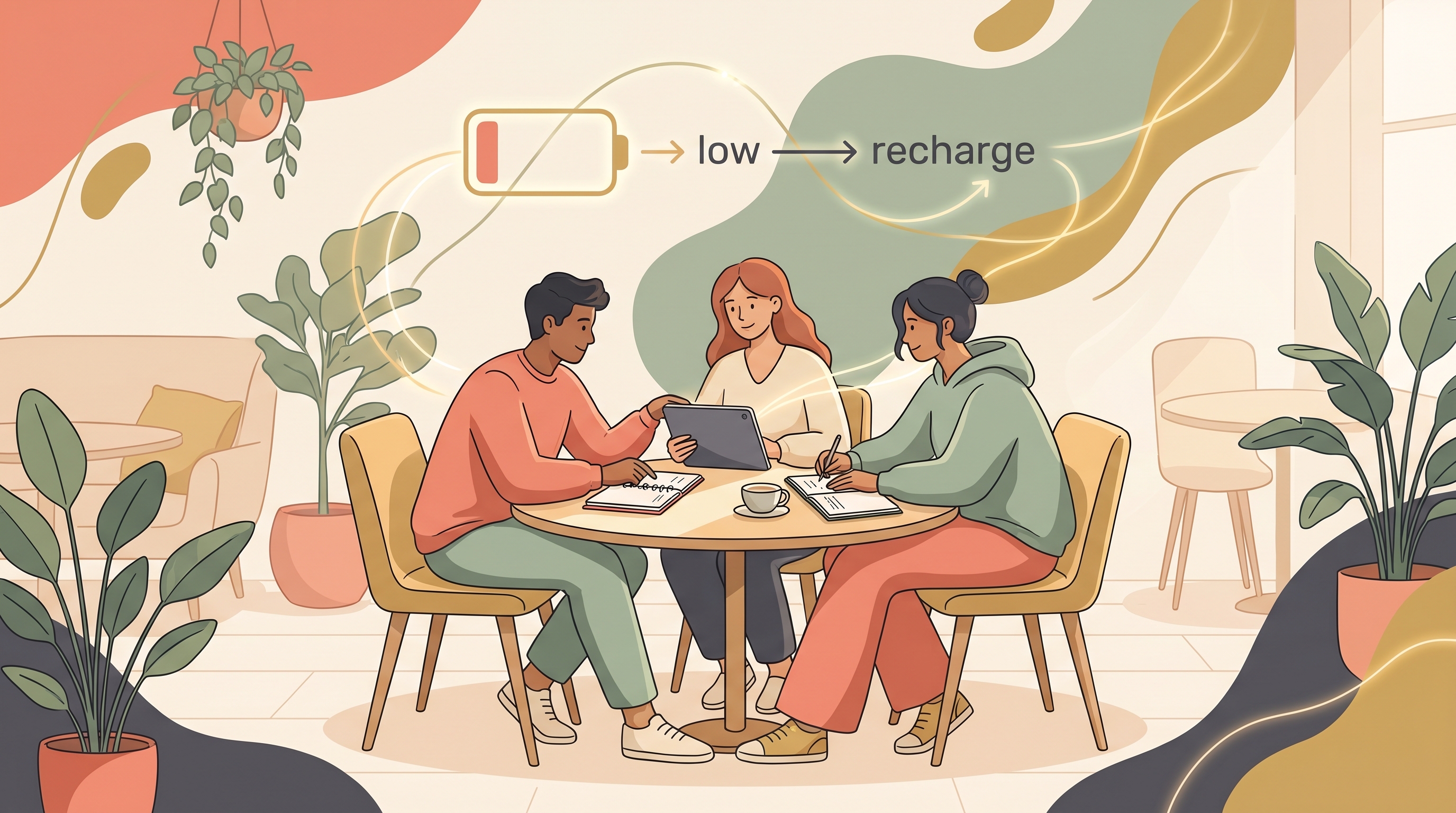
Your social battery is the finite mental and emotional energy you spend during social interaction. When it’s full, talking to people feels easy — maybe even energizing. When it’s low, the same conversation that would normally feel fine becomes effortful, something you want to escape.
It’s a useful model because it frames social energy as a resource: something that depletes and recharges based on conditions, not a permanent personality trait.
The concept gets attached to introversion a lot, but that’s only part of the picture. Extroverts have social batteries too. The difference is that extroverts tend to recharge through social contact, while introverts typically recharge through solitude. But both can run low after enough hours in the right — or wrong — kind of social context.
Why Your Battery Drains at Different Rates
Not all social time costs the same energy. A few factors that affect how fast you deplete:
Cognitive load of the conversation. Small talk with strangers usually costs more than a long conversation with a close friend. With strangers, you’re managing impressions, decoding cues, and filling silence — all at once.
The role you’re playing. Being “on” — a host, a speaker, the person expected to carry the energy — costs more than just being present. Performing a social role adds a layer of effort on top of basic interaction.
Environment and stimulation. Loud venues, crowds, and bright lights pile sensory load on top of social load. You can drain faster without anyone doing anything wrong.
Relationship history. New friendships cost more energy than established ones. This isn’t a reason to avoid new people — it’s just worth knowing so you don’t misread early social exhaustion as a sign the friendship isn’t worth building.
What It Feels Like When You’re Running Low
The signals aren’t always obvious, especially if you’re used to pushing through. Common ones include:
- Giving shorter answers than you normally would
- Feeling irritated by things that wouldn’t usually bother you
- Wanting to check your phone mid-conversation
- A vague sense of dread before a social event you’d normally enjoy
- Physical tiredness after socializing, even if you sat still the whole time
The tricky part is that these signals tend to show up after you’ve already overcommitted. By the time you notice them, you’ve already said yes to three things this weekend.
The False Read: Low Battery vs. Not Liking Someone
This is where the social battery concept trips people up the most.
When your battery is depleted, everyone becomes harder to be around — including people you genuinely like. If you’re running on empty and a close friend texts asking to hang out, your gut reaction might be reluctance or even mild dread. It’s easy to misread that feeling as “I don’t really want this friendship” when the actual cause is exhaustion, not disinterest.
The reverse happens too. You can feel warm and connected with someone when your battery is full, then feel distant from the same person two days later after a draining week. Neither reading accurately reflects the relationship — you’re measuring a fluctuating internal resource, not a stable preference.
A quick check: ask yourself whether you’d feel differently after a full night of sleep and a quiet morning. If the answer is probably yes, you’re reading battery level, not relationship quality.
Illustrative Example
Say Jamie works in a customer-facing job and spends six hours a day managing people’s expectations and keeping things smooth. By Thursday, Jamie’s social battery is noticeably low — not from anything dramatic, just from accumulated output.
A close friend texts asking to grab dinner Friday. Jamie feels a flicker of resistance and starts composing a soft cancellation.
But Jamie pauses and runs a quick check: Is this about the friendship, or is this about the week? The honest answer is the week.
Instead of canceling, Jamie replies: “I want to, but I’m a bit low-energy — can we do something low-key instead of going out? I’ll come to yours.” The friend says yes. They have a genuinely good time because the format matched Jamie’s actual energy level.
The key mechanism: Jamie didn’t cancel the social connection, just adjusted the format to match the available resource. That’s a meaningfully different decision than avoiding the friend entirely.
A Decision Rule You Can Reuse
Managing your social battery isn’t about protecting yourself from people — it’s about matching format and frequency to your actual energy state. Before saying yes to a plan, run through three quick questions:
- What’s my battery level right now? (Full / Half / Low / Empty)
- What’s the cost of this format? A party with strangers and a quiet dinner with one friend are very different asks.
- What’s my recharge window before this happens? Will you have time to recover, or will you show up already depleted?
If your battery is low and the format is high-cost and your recharge window is short — say no, or propose a lower-cost version.
If only one of those is true, you probably have enough to work with. But build in recovery time after.
Low-cost social formats to keep in your back pocket:
- A 30-minute walk with one friend instead of a group dinner
- A phone call instead of a video call (less performance pressure)
- Watching something together at home rather than going out
- A brief check-in text instead of a full hangout
These aren’t lesser versions of connection. They’re appropriately sized ones.
What Actually Recharges You
Recharging isn’t just “being alone.” The activities that restore social energy are the ones that don’t require you to manage how you’re coming across. That’s the core mechanism.
Reading, walking, cooking, watching something you enjoy — these work because there’s no social performance involved. You’re not tracking anyone else’s emotional state or managing impressions.
Sleep matters more than most people account for. Low sleep raises the cost of every social interaction and makes neutral situations feel draining or threatening. A bad night’s sleep can flatten your battery before you’ve even talked to anyone.
Exercise helps too, for more physiological reasons — it reduces the baseline stress level that makes interaction feel costly in the first place.
Building Rhythms That Prevent Burnout
A few habits that help before you hit empty:
Leave buffers between high-drain events. Don’t schedule a work happy hour the night before a family dinner. Even a few hours of quiet between big social events makes a real difference.
Notice your weekly rhythm. Most people have higher and lower energy days based on their schedule, sleep, and accumulated demands. Scheduling social plans on your naturally higher-energy days isn’t antisocial — it’s just sensible.
Be honest with people you trust. “I’m a bit low-energy right now — can we do something chill?” is information, not an excuse. Most people are relieved when you name it, because it takes the pressure off them too.
Tools that reduce coordination friction help here as well. Feelr lets you signal your current mood — whether you’re up for something social or need a quieter kind of connection — so your friends can see when your energy actually matches theirs. It removes the awkward back-and-forth of figuring out whether anyone actually wants to make plans right now, without replacing the actual work of staying connected.
Where This Advice Breaks
Managing your social battery assumes the problem is energy management, not chronic avoidance. There’s a real difference between protecting necessary recovery time and using “low battery” as a permanent reason to pull back from people.
If your battery feels consistently depleted even after rest — and you find yourself steadily withdrawing from people you care about — that’s worth paying closer attention to. Persistent social withdrawal can be a symptom of depression, anxiety, or burnout, not just a scheduling problem.
The social battery model is a useful tool for day-to-day calibration. It’s not a complete explanation for why connection sometimes feels hard.
The Short Version
Your social battery is real, it runs at different rates depending on context, and depleting it doesn’t make you antisocial — it makes you human.
The practical moves: notice what drains you fastest, match your social formats to your actual energy level, recharge through genuinely low-stimulation activities, and stop overcommitting before you realize you’re already running low.
And the next time a friend texts you on a Thursday night — check your battery before you cancel. Sometimes the answer is a quieter version of yes, not no.
Ready to connect with friends who match your vibe? Download Feelr and start matching today.